
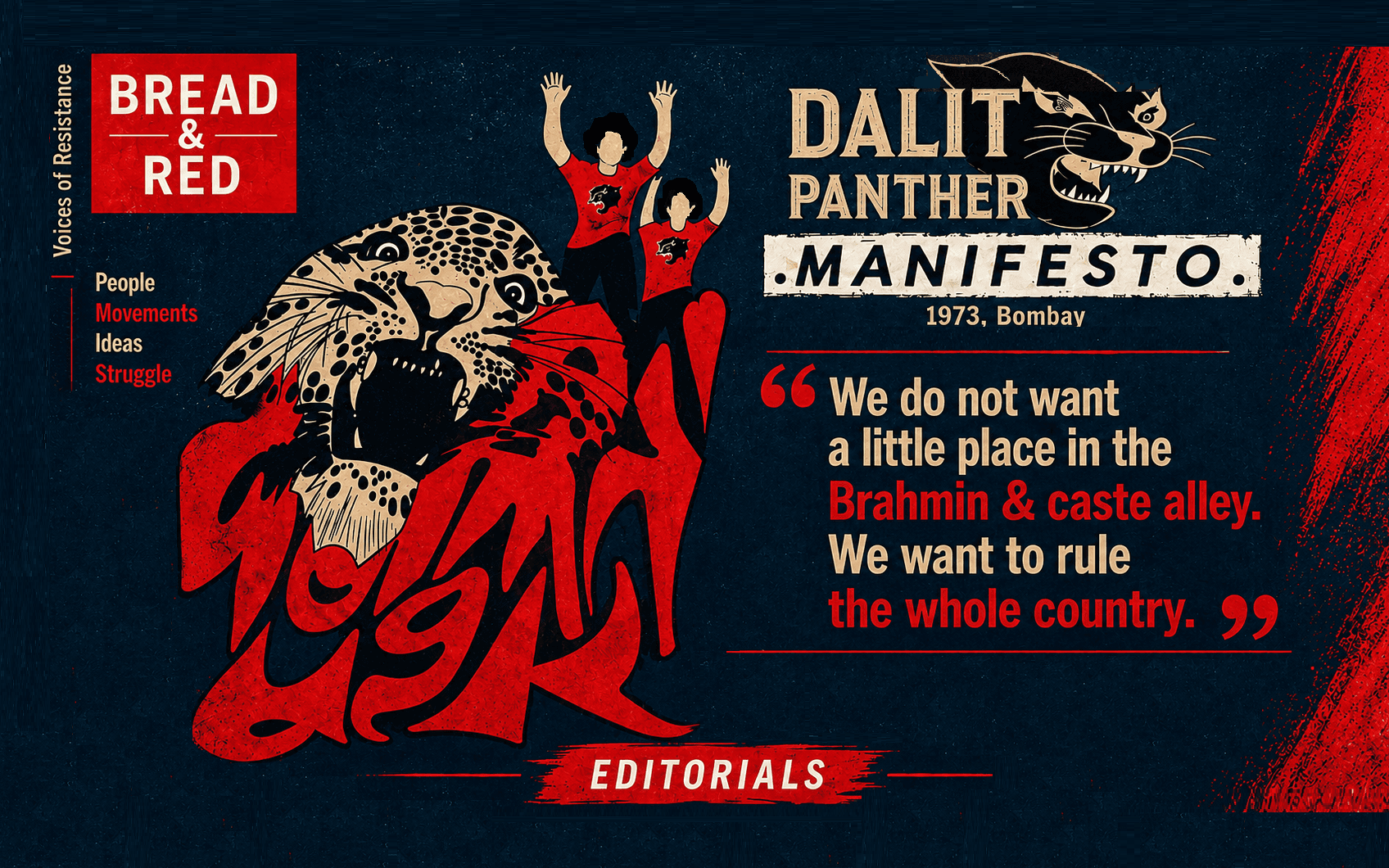
The 1970s were a period of profound political upheaval in India. The country had just emerged from the war with Pakistan that led to the creation of Bangladesh. Economic crises, political instability, agrarian tensions following the Green Revolution, and escalating caste violence created a climate of unrest across the country. It was in this context that the Dalit Panthers was founded in Mumbai on 9 July 1972, igniting a militant movement that spoke not only for Dalits but for all oppressed and working class people.
The Panthers sharply criticised the Republican Party for abandoning Ambedkar's revolutionary legacy. According to the manifesto, the party had become trapped in electoral politics, factionalism, and the pursuit of concessions, while atrocities against Dalits continued unabated. The Panthers argued that liberation could not be achieved through caste-based bargaining alone but required class consciousness, humanism, and a broader struggle of all oppressed people.
Unlike narrow identity politics, their uncompromising politics made them frequent targets of state repression, surveillance, and police violence. Yet within a few years, the Dalit Panthers transformed the political imagination of an entire generation. They linked the fight against caste oppression with the struggle against economic exploitation and inspired anti-caste movements far beyond India. 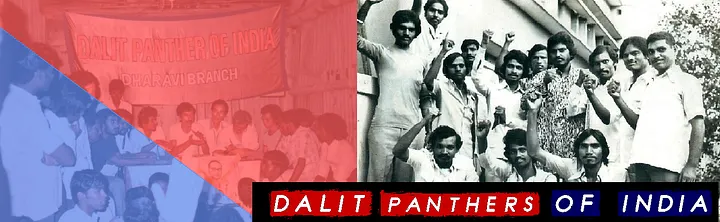
The Dalit Panthers became the first major movement to consciously fuse the ideas of Dr. B.R. Ambedkar with Marxist politics. Rejecting both caste oppression and class exploitation, they sought to build a revolutionary movement that challenged the foundations of Indian society. Thousands of young Dalits abandoned reactionary and caste-ridden political formations and joined the Panthers' struggle.
EXCREPTS FROM THE DALIT PANTHER MANIFESTO 1973
Members of scheduled castes and tribes, Neo-Buddhists, the working people, the landless and poor peasants, women and all those who are being exploited politically, economically and in the name of religion.
I) Revolutionary parties set to break down the caste system and class rule. Left parties that are left in a true sense.
2) All other sections of society that are suffering due to the economic and political oppression.
I) Power, wealth, price.
2) Landlords, capitalists, money-lenders and their lackeys.
3) Those parties who indulge in religious or casteist politics, and the government which depends on them.
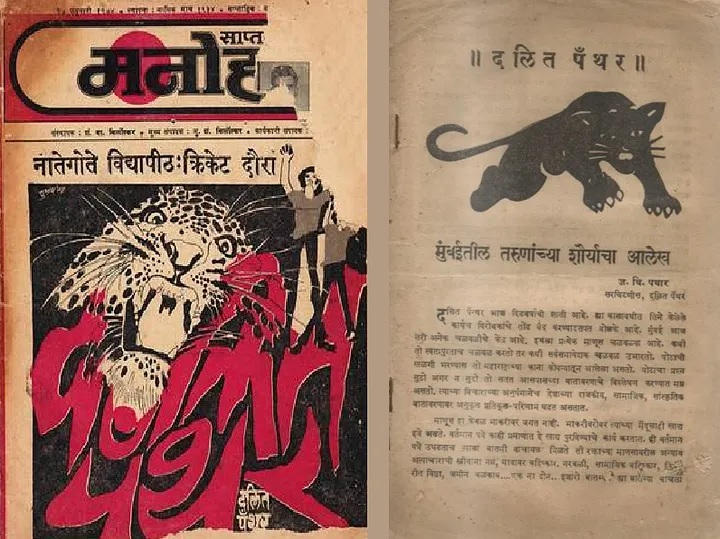
Burning Questions before Dalits today
I) Food, clothing, shelter
2) Employment, land, untouchability
3) Social and physical injustice
The struggle for the emancipation of the dalits needs a complete revolution. Partial change is impossible. We do not want it either. We want a complete and total revolutionary change. Even if we want to move out of the present state of social degradation alone, we will have to exercise our power in economic, political, cultural fields as well. We will not be satisfied easily now. We do not want a little place in the Brahmin alley. We want to rule the whole country. We are not looking at persons but at a system. Change of heart, liberal education, etc. will not end our state of exploitation. When we gather a revolutionary mass, rouse the people, out of the struggle of this giant mass will come the tidal wave of revolutions. Legalistic appeals, requests, demands for concessions, elections, satyagraha — out of these, society will never change. Our ideas of social revolution and rebellion will be too strong for such paper-made vehicles of protest. They will sprout in the soil flower in the mind and then will come forward with full force with the help of steel-strong means.
Dalit Panther is not a mere slogan
The way we look at our questions is the first step to solving them. Panthers will paralyzingly attack untouchability, casteism and economic exploitation. This social system and state have taken maya cruel path to convert us into slaves. Turned us long back into ‘shudras’. In the present modem forms of slavery there are mental chains of slavishness. We will try to break them. In our struggle we will become free.
1) More than 80 per cent of India’s population lives in the villages. Of those, landless peasants are 35 per cent, and 33 per cent of all landless agricultural labourers belong to scheduled castes. (Those Dalit poor peasants who do own pieces ofland, own a negligible amount). The question of landlessness of the dalit peasants must be resolved.
2) Landless peasants must immediately get excess land through the application of the Land Ceiling Act. Waste and jungle land must likewise be distributed.
3) Feudal survivals are still to be found in the villages. Due to this, dalits are cruelly oppressed and exploited. Landlords and rich peasants get social prestige along with wealth. Due to this, the atrocities on dalits have grown endemic. This system has clamped itself on the dalit’s chest, affecting every part of his life, from day to day living to the deeper economic questions. This system must be destroyed.
4) The wages of landless labourers must be increased.
5) Dalits must be allowed to draw water from public wells.
6) Dalits must live, not outside the village in a separate settlement, but in the village itself.
7) All means of production must belong to the dalits.
8) Exploitation by private capital must cease.
9) Social, cultural and economic exploitation must be removed and socialism must be built in India. Misleading nationalization must give away to a true introduction of socialism.
10) All dalits must be assured of daily wages.
11) Unemployed dalits must be given unemployment benefits.
12) All dalits must be given free education, medical facilities, housing and good quality cheap grains.
13) When giving employment in educational institutions, the requirements to declare one’s caste and religion must be immediately removed.
14) The government must stop giving grants to religious institutions immediately and the wealth of religious places must be used for the benefit of dalits.
15) Religious and casteist literature must be banned.
16) The division in the army along caste lines must be ended.
17) Black marketeers; hoarders, money-lenders and all those exploiting the people economically must be destroyed.
18) The prices of essential commodities must be refunded. We will build the organization of workers, dalits, landless, poor peasants through all city factories, in all villages. We will hit back against all injustice perpetrated on Dalits. We will well and truly destroy the caste and varna system that thrives on the people’s misery, which exploits the people, and liberate the dalits. The present legal system and state have turned all our dreams to dust. To eradicate all the injustice against the dalits, they must themselves become rulers. This is the people’s democracy. Sympathizers and members of the Dalit Panthers be ready for the fmal struggle of the dalits.
Though formally disbanded in 1977, the Panthers left behind a legacy far greater than their brief existence. In a country where caste violence, social exclusion, and inequality remain deeply entrenched, their questions continue to resonate. What does freedom mean for the oppressed? Can social justice exist without economic justice? Can caste be destroyed without transforming the structures of power that sustain it?
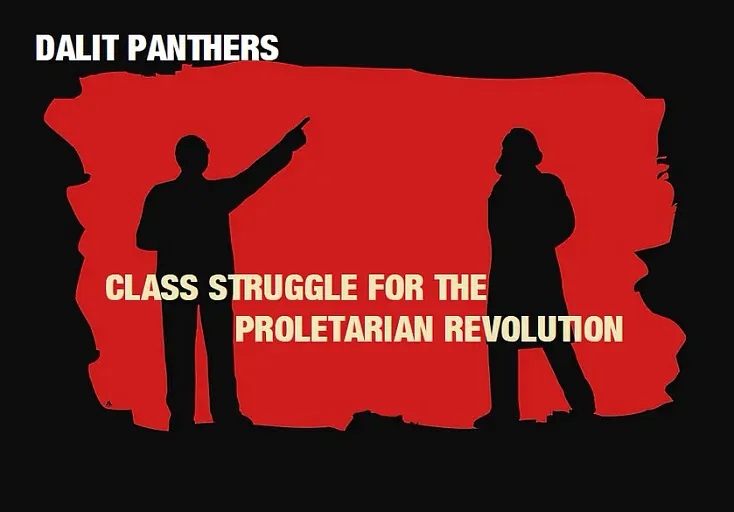
More than fifty years later, the revolutionary spirit of the Dalit Panthers endures. They classified “American imperialism” in the same category as “Hindu feudalism”; with both being examples of caste hierarchy. The Panthers’ Manifesto claimed that while Hindu feudalism may have spawned caste inequality, its extension by the modern Indian state had created oppression “a hundred times more ruthless. Their radical stance and activism made their members frequent targets of State Violence, surveillance and brutality. The movement may have disappeared, but the questions it raised—and the demand for a society free from caste and exploitation—remain as urgent as ever. The Dalit Panthers’ Manifesto defines Dalits as “all those who are exploited politically, economically and in the name of religion.
The Dalit Panthers of India was a radical political organisation formed in 1972 in Mumbai , which advocated for a revolutionary activism of sub-altern working class people by integration Anti-caste agitation and Dalit empowerment along with Class-struggle. The Dalit Panthers of India came into formation through the revolutionary influence of “The Black Panther Party (BPP) of America”
The Black Panther Party which was a Marxist-Leninist and black power political organization which retaliated against White supremacy and racism in the United States of America with the agenda to overthrow the Imperialist system.