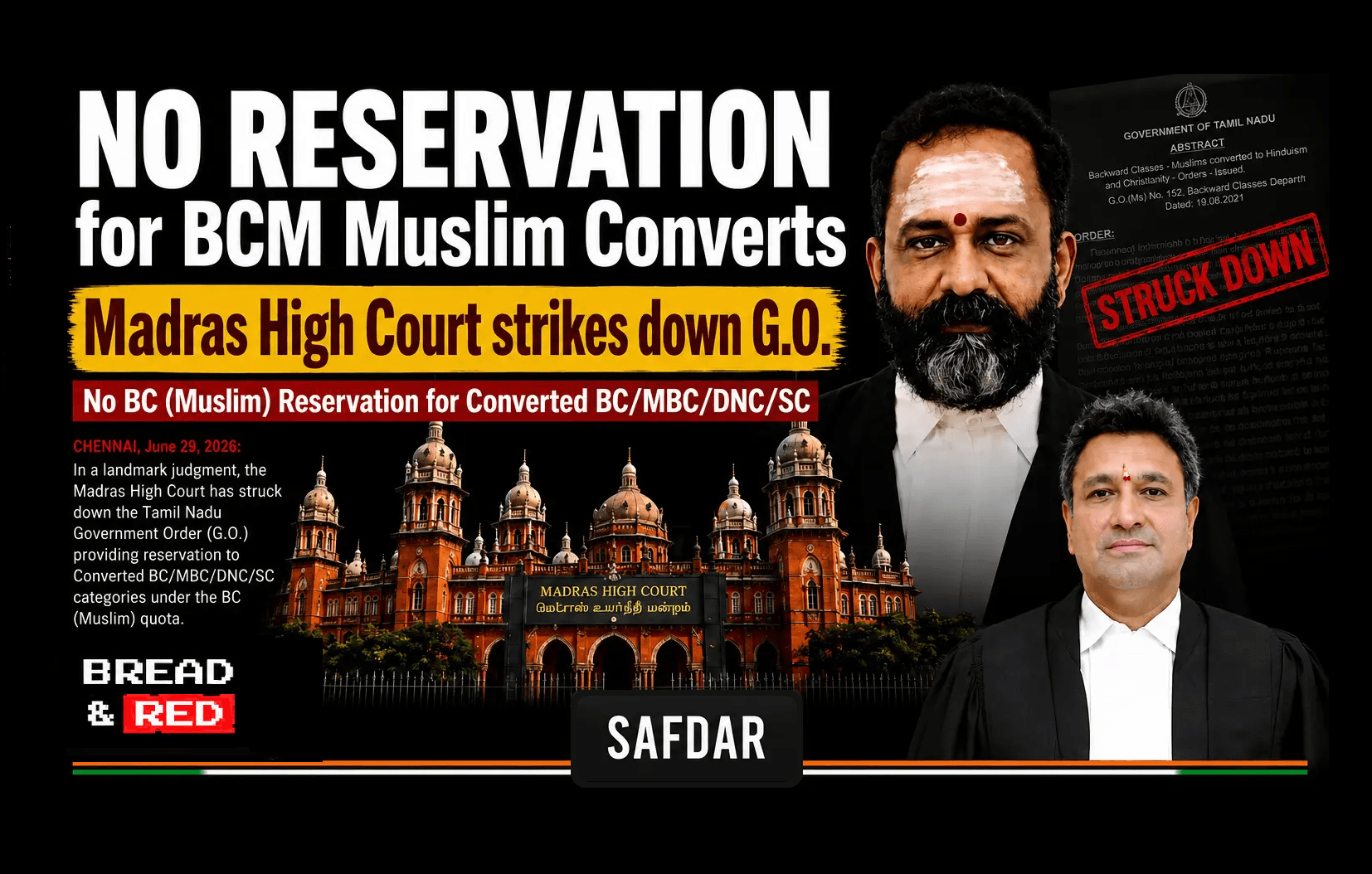
The recent Madras High Court judgment striking down G.O. (Ms.) No. 31 on BC(M) Reservation has ignited a serious constitutional and political debate in Tamil Nadu. The Division bench comprising of Justice G.R.Swaminaathan and Justice P.B. Balaji ordered this in a case concerning the issuance of a Muslim Lebbai community certificate, and has now grown into a much larger discussion on reservation and religious freedom.
It started when a petitioner approached the Court with an individual grievance, praying to quash the rejection of his online application and seeking a legal directive to compel authorities to issue him a "Muslim Lebbai" community certificate. On 11.06.2026, the Government was suo motu impleaded as a party.
Instead of confining itself to this specific relief, the Court struck down G.O. (Ms).No.31, dated 09.03.2024. This constitutes clear judicial overreach, as the Court tested the validity of a Government Order suo motu.
Judicial Implications and Legal Contentions :
When Examining the various prospects of Judicial proceedings many shocking facts surface here:
Typically, a G.O. is declared unconstitutional only when an aggrieved party files a specific petition directly challenging its validity. Yet, Paragraph 5 of the judgment explicitly notes that the matter was posted "only for the purpose of testing the validity of G.O (Ms)No.31."
The Judgement ruled that converts to Islam from BC/MBC/DNT/SC cannot claim BC Muslim status, that means they fall under the Open Category (OC).
The core constitutional principle underlying reservations in India is to remedy deep-rooted social and educational backwardness. A change in religious identity does not instantly erase lifelong social marginalization or lack of educational access. Denying converts entry into recognized backward groups ignores the sociological reality that they continue to face the same systemic disadvantages post-conversion.
By simplistically categorizing a convert as "only a Muslim and that's all there is to it," the Court places a highly marginalized convert from a BC, MBC, DNC or SC background into the same competitive pool as socially and educationally advanced Muslim groups.
This treats unequals equally, directly violating the constitutional mandate of substantive equality under Article 14.
An Impediment to Religious freedom & Article 25
This Judgment acts as a severe deterrent to the fundamental right (Article 25) to freely choose, profess, and practice a religion of one’s choice, as individuals are forced to choose between their spiritual beliefs and their access to public employment or education.
The Petitioner's Advocate said that he has given a change of Vakalat and time has not given to the Petitioner to have another advocate and the Court records that the AAG explicitly "called upon us not to strike down the said G.O." (Paragraph 7).
The AAG established that the G.O. was not issued arbitrarily; rather, it was enacted following detailed deliberations with stakeholders and a formal, written recommendation from the Tamil Nadu Backward Classes Commission dated 06.02.2024. Because the Commission's statutory findings and recommendations on backwardness are functionally binding on the State, the Government duly issued G.O. 31 to execute them.
This government policy does not disrupt the existing social balance because it is highly selective. A person converting to Islam from a "forward community" would never qualify for BCM status. The G.O. merely ensures that individuals who already belonged to marginalized categories (BC, MBC, DNC or SC) and enjoyed reservation benefits do not lose those vital opportunities solely due to conversion.
The AAG argued that the G.O. has already been accepted and enforced in several Division Bench judgments, such as WA No. 2813 of 2021 but rejected by this court.
Furthermore, the AAG argued that once a Jamath issues an acceptance certificate, revenue authorities cannot question it, and the Court is not justified in interfering with either the Jamath's autonomous decision or the expert commission's policy framework.
Conflating facts & Cases
Paragraph 6 of the judgment reveals that the same Judge had previously upheld a TNPSC decision on 01.12.2022 to deny a convert backward-class benefits. When the State subsequently issued G.O. 31 to protect converted BC, MBC, and SC individuals, the Judge struck it down suo motu in this case.
To justify this, invokes Bharathidhasan University case, a precedent meant strictly for situations where an authority acts completely without statutory permission. That case is entirely inapplicable here because G.O. 31 was issued by the proper state department following the legal, statutory procedure laid down by the Tamil Nadu Backward Classes Commission. (Paragraphs 5 and 7)
Muslims - Not a homogenous Social group
The Court heavily relied on outdated or irrelevant case law to justify its conclusion. The Michael case (1952) is over 70 years old and fails to reflect modern reservation jurisprudence. In 1952, there was no separate BCM quota in Tamil Nadu. Today, the law officially recognizes that Indian Muslim society is stratified into distinct socio-economic communities. Applying a 1952 rule treats all Muslims as a single, homogenous block, which is factually, sociologically, and legally incorrect. (Paragraphs 10 and 11)
Similarly, the C. Selvarani case (2024) dealt strictly with Scheduled Caste individuals converting to other religions, a domain governed by a rigid Presidential Order under Article 341. The present case involves the identification of BC/MBC layers under Articles 15(4) and 16(4), where the State Government possesses explicit, flexible constitutional powers to identify backwardness. The Judge wrongly conflated a strict presidential mandate with a state-level policy framework. (Paragraph 10)
K.P. Manu (2015) case dealt with a re-convertee returning to Hinduism from Christianity, making its application to a first-generation Muslim convert legally flawed. More importantly, the Supreme Court in K.P. Manu ruled that legal status post-conversion depends entirely on community acceptance. By striking down G.O. 31, this judgment fundamentally contradicts K.P. Manu by rejecting the local Jamath’s explicit, formal acceptance of the petitioner. (Paragraph 10)
By turning an individual's certificate grievance into a suo motu assault on an expert-backed government order, the judgment commits judicial overreach, ignores modern sociological stratification within minorities, and misapplies distinct precedents to strip marginalized converts of their constitutional right to substantive equality.
Because the AAG argued that the said G.O. had been accepted and enforced in several Division Bench judgments, the state government must file a review petition within the High Court requesting that the entire matter be referred to a three-judge bench to resolve the conflicting judgments between the co-equal benches.
Judicial overreach
While, the present controversy, however, centres not on the judge personally but on the constitutional implications of the judgment itself, historical track record gives a different perspective. Justice G. R. Swaminathan has previously been the subject of public controversy over some of his judicial observations and orders. In late 2025, Members of Parliament from the INDIA bloc parties, submitted an impeachment notice against him alleging judicial misconduct and bias. Various advocate unions and political parties like the CPIM protested in favor of impeachment in front of the Madras High Court.
Advocate Salman states "While right-wing media describe the impeachment effort as an attack on judicial independence, I would argue that the silence of the legal community on certain judgments and the political and ideological interference in verdicts are also attacks on the Constitution and the Judiciary."
- SAFDAR
Note : As per Adv. Vanchinathan's Statement, AAG appeared before the court only through video conferencing.